



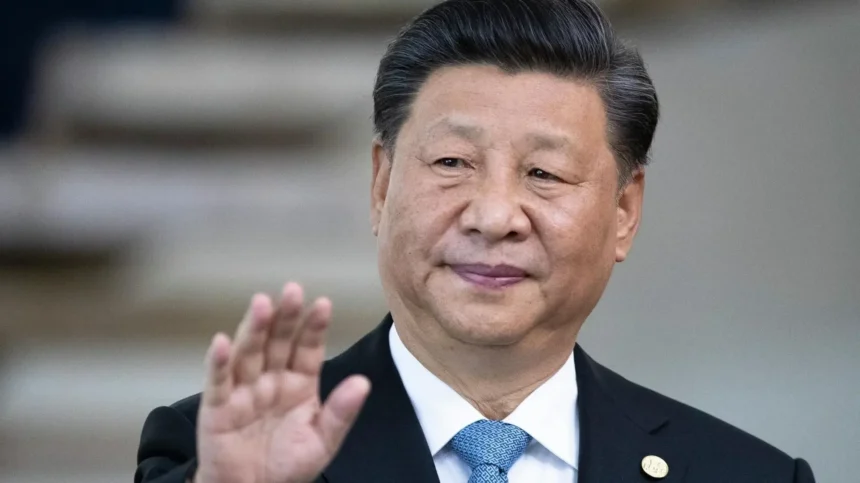
Beijing told EU officials that China’s second-ranking leader, Premier Li Qiang, rather than Xi, would meet the heads of the European Council and the Commission at the summit in Brussels.
EU-China summits traditionally alternate between Brussels and Beijing. The premier usually attends the summit in Brussels, while Xi hosts it in Beijing, but the EU believes the importance of this meeting, marking the half-century anniversary of diplomatic relations, means the Chinese president should attend, people familiar with the matter said.
Both sides said talks were continuing, but the initial refusal confirmed the view of many in Brussels that China will not back up with concrete action its warm words about the need for cooperation in the face of US President Donald Trump’s assault on the multilateral world order.
This year’s summit comes at a particularly sensitive time for EU-China relations.
Tensions between Brussels and Beijing have risen since Russia’s full-scale invasion of Ukraine in 2022, with the EU accusing China of supporting the Kremlin. The bloc has also imposed tariffs on imports of Chinese electric vehicles, arguing that they are subsidised.
EU officials believe that China, which last year ran a trade surplus with the bloc of €304.5 billion, is not doing enough to rebalance trade by cutting subsidies for its industry and lowering trade barriers for foreign companies doing business in the world’s second-largest economy. “Relations are thawing,” one senior EU diplomat said. “It’s a change of tone, not substance. Their policies will not change, and the same is true for us.”
Read also
Lu Shaye, China’s former ambassador to France who is now Beijing’s special representative for European affairs, said China’s policy towards Europe had always “stood for peace, friendship, cooperation and mutual benefit”.
“This has never changed. It is just that, in contrast with the current US policy towards Europe, China’s policy towards Europe looks even more far-sighted, fair and reasonable. I hope this can serve as a wake-up call [for Europe],” he said.
Known for his aggressive diplomacy, Lu caused an uproar in Europe last year when he questioned Crimea’s belonging to Ukraine and the sovereignty of former Soviet republics such as EU members Latvia, Estonia and Lithuania. Some commentators saw his appointment to lead China’s diplomatic relations with Europe as a hardening of Beijing’s position.
“China has even said it expects Europe to have a seat at the table [in the peace talks on Ukraine],” the diplomat added. “I am also hearing less talk about EU-China trade frictions. They still exist, but they are getting less attention.”
EU trade chief Maroš Šefčovič is due to visit China at the end of this month. Spanish Foreign Minister José Manuel Albares said last month that the EU should also see potential opportunities. When China “can be a partner, let’s take advantage of it,” Albares said.
“Informal talks are currently under way both on setting a date for this year’s EU-China summit and on the level of representation,” an EU official said.
China’s foreign ministry said it had “no information to offer” on the matter.