




What Tripoli said
Libya’s acting Foreign Minister Taher Salem al-Baour met Libya’s ambassador to Ukraine, Osama Mohamed Ablgasem, in Tripoli. According to a Libyan Foreign Ministry statement cited by Ukrinform, the ambassador “was recalled for consultations after Ukraine’s attack on the city of Benghazi”. Al-Baour reaffirmed Libya’s rejection of the actions of Ukrainian forces, saying they ran counter to international law, international conventions and norms.
The minister said such actions undermine Libya’s security and stability and harm Libyan-Ukrainian relations. During the meeting, the ambassador briefed him on the mission’s work in Kyiv and on the situation of Libyan citizens in Ukraine, Interfax-Ukraine reported, citing the state news agency LANA.
The ambassador was recalled for consultations after Ukraine’s attack on the city of Benghazi.
Libyan Ministry of Foreign Affairs
Sybiha’s call did not help
The decision came despite Kyiv’s efforts to defuse the situation. On 26 November Ukrainian Foreign Minister Andrii Sybiha spoke by phone with al-Baour. He reaffirmed Ukraine’s respect for Libya’s sovereignty and territorial integrity, expressed regret over the unintended consequences of the operation and offered condolences to the Libyan people. Sybiha stressed that the strikes were aimed solely at Russian military assets involved in the war against Ukraine, not at Libya, and that Kyiv had no intention of extending the war to other countries.
As early as 23 November the Libyan Foreign Ministry said the country was not a party to the Russia-Ukraine war and demanded an official explanation from Kyiv. As Infokava reported, after a call with Italian Prime Minister Giorgia Meloni, Volodymyr Zelensky acknowledged that the operation had been carried out without prior coordination with European partners.
The paradox: Benghazi is not controlled by Tripoli
The protest comes from a government seen as close to Kyiv: in July Sybiha thanked al-Baour for supporting Ukraine’s territorial integrity, the Argentine outlet Infobae noted. Yet Benghazi is not under Tripoli’s authority. It is the seat of a rival eastern government led by Osama Hammad, which lacks international recognition and relies on the Libyan National Army of Field Marshal Khalifa Haftar, a long-standing ally of Moscow.
Russia has worked with Haftar for years and has access to the Al-Khadim and Al-Jufra air bases, which it uses as a logistics hub for operations in Africa. After the fall of the Assad regime in Syria in December 2024, the Kremlin moved part of its equipment from Tartus and Hmeimim to Haftar’s territory, according to Infobae.
Read also
What is known about the strike’s aftermath
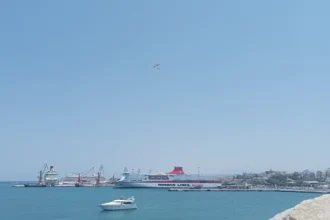
Overnight on 22 November, seven Ukrainian-made sea drones attacked the corvette Merkury at Benghazi’s naval base, and the cargo ship Angara was hit the same day. Zelensky called it an “exemplary operation” and said the corvette sank along with a Ka-27 helicopter. Two Libyan officials told AP the ship was badly damaged, and a satellite image from Vantor shows it capsized at the pier.
On 25 November two naval officers of Haftar’s army died of their wounds. Its command promised to respond “at a time and place of its choosing”, and the eastern government asked the UN General Assembly and Security Council for an international investigation. According to Ukrinform, the eastern Libyan authorities will also demand compensation from Ukraine.
Using satellite images, Radio Liberty found that the entrance to Benghazi port is now blocked by a boom barrier similar to those Russia uses in its Black Sea ports. The day after the attack, a Russian An-124 transport aircraft landed at the Al-Khadim air base. According to Reuters, cited by Infobae, a Russian convoy carrying military vehicles to Libya turned back in the Mediterranean, and a second, escorted by the frigate Admiral Golovko, stopped off the coast of Algeria.
Europe’s reaction and what comes next
Italy and Germany condemned the Ukrainian operation, while France called it an exercise of Ukraine’s right to self-defence. Recalling an ambassador for consultations is a common diplomatic signal of displeasure, but not a break in relations. Ukraine and Libya established diplomatic relations on 17 March 1992, and trade, including supplies of Ukrainian grain, remains the basis of their cooperation. Ukraine’s Foreign Ministry had not officially responded to Tripoli’s decision at the time of publication.