



What we know
A coastguard official told Reuters that more than 1,000 people were rescued in separate operations at sea on Saturday alone, while about 700 more reached the shore on their own. Off Gavdos, Greece’s southernmost island, a boat struck rocks, killing two people and injuring four. On Sunday drones operated by the EU border agency Frontex spotted three more boats and 190 people were rescued. Kathimerini reported that around 600 more migrants may be near Crete.
Plevris said about 2,500 migrants are currently on Crete, including some 1,300 in Heraklion and 300 in the eastern town of Ierapetra. Most of the new arrivals are Sudanese nationals fleeing war, followed by people from Bangladesh. Sudan’s civil war between the army and the Rapid Support Forces has been raging since April 2023 and has forced millions from their homes, and growing numbers of Sudanese are heading to Europe via Libya. The minister described the sea crossing from Libya as one of the most dangerous migration routes.
Sleeping in the open
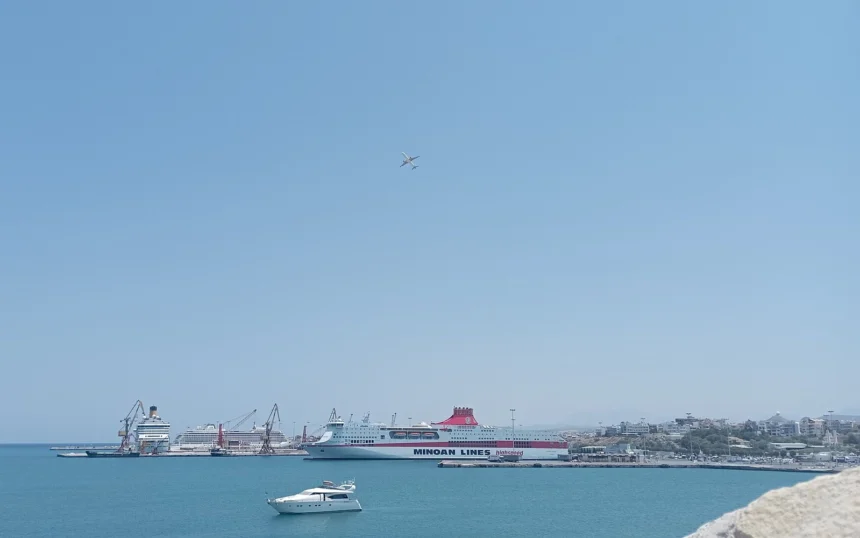
Reception facilities on the island are overwhelmed. Hundreds of people have been housed in a sports hall in Heraklion, while others remain outdoors at the port. Heavy rain and gale-force winds are forecast for Crete on Monday. Authorities sent 11 tents and two prefabricated units to Ierapetra after a site previously used to house migrants was deemed unsuitable.
“The situation has spiralled out of control. As we speak, almost 2,000 migrants are currently stranded at the port of Heraklion, exposed to the cold and to any rain that may come,” deputy regional governor for social policy Stelios Vorgias told the BBC. He said Crete was “responding out of a sense of humanity” to find a temporary solution so that women and young children were not left in the rain overnight.
They are human beings, and human beings retain their human rights wherever they are and under any circumstances.
Alexis Kalokairinos, mayor of Heraklion (via the BBC)
Who Athens blames
Plevris accused the authorities in eastern Libya of failing to check migrant boats. He said their attention had been distracted last week by drone attacks on Russian naval targets in the country. It was near Benghazi, in eastern Libya, that Ukrainian sea drones on 23 November sank the Russian corvette Merkury.
The minister said some of the new arrivals would be taken by ship to camps on the Greek mainland within the week, and those eligible for refugee protection would be placed in state-run facilities. The authorities will also speed up construction of a reception centre on the outskirts of Heraklion.
Read also
A record year for Greece
According to Kathimerini, more than 25,000 migrants have reached Crete since the start of the year, out of at least 41,000 who have entered Greece by land and sea. UN figures show this already exceeds the total for the whole of 2025. Crete has become one of the main gateways to Europe for people from Africa and the Middle East.
At the same time Greece is tightening its migration policy. This year it has accelerated the return of rejected asylum seekers. On 16 November in Vienna, Greece, Austria, Denmark, Germany and the Netherlands announced plans to set up a “return hub” in Rwanda for migrants whose asylum claims have been finally rejected. The first transfers are planned by 2027, but no formal agreement has yet been signed and the governments have not said how many people would be sent.
The governments say the scheme would speed up the removal of people with no right to remain in Europe. According to the European Commission, 669,365 first-time asylum applications were lodged in the EU in 2025; on average 45% are approved, while about 90% of rejected applicants end up staying in the bloc, Al Jazeera reported. Human Rights Watch and Amnesty International oppose the plan, saying such third-country transfers lead to arbitrary detention and other abuses.
Pressure is also growing on other routes. On 14 November almost 1,500 migrants reached Spain’s Canary Islands in a single day, the highest number since 2020.