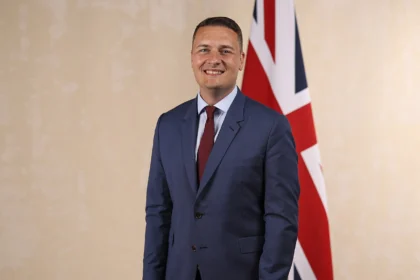




Budanov was speaking at the “Dialogue for Unity” event in response to a question from a Novyny.LIVE journalist.
Interceptor drones, jet drones — they already exist. We are already moving from prototypes to, let’s say, the first serial models.
Kyrylo Budanov, head of the Office of the President
“Now all this needs to be scaled up,” he added. Asked what share of jet targets is already being shot down, Budanov declined to answer: “I am not ready to answer that question.”
Why jet Shaheds are a special threat
Ordinary Shaheds fly relatively slowly, so mobile fire groups and first-generation interceptor drones flying at about 300 km/h work well against them. Jet-powered strike drones, according to Euronews, can reach around 500 km/h, making them almost impossible to catch with older interceptors.
According to the same report, air defence crews near Kyiv sometimes have only 10–15 seconds to react as such a drone approaches, so in some cases far more expensive surface-to-air missiles have to be used against them.
The difference in effectiveness is significant. According to official estimates cited by ukrmedia, the rate of countering jet targets in September was 55–57%, while ordinary Shaheds are shot down or jammed in more than 90% of cases.
How interceptor drones work
An interceptor drone is a small, fast unmanned aircraft that an operator or autopilot steers towards an enemy drone in flight, destroying it by ramming or by detonating a warhead next to the target. Such systems are much cheaper than air defence missiles, can be mass-produced and their crews can be deployed quickly along the routes Shaheds fly.
Read also
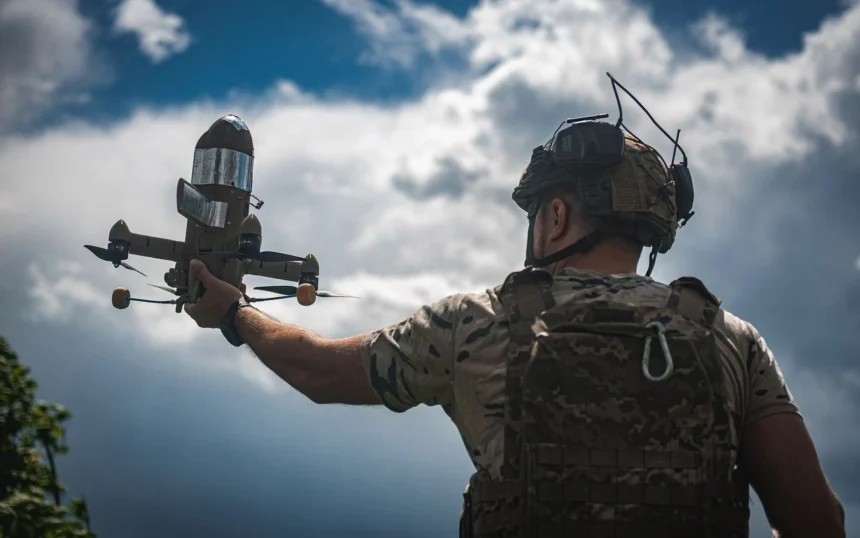
The first interceptors, including the Sting being launched in the photo by a soldier of the 114th Territorial Defence Brigade, are widely used by Ukrainian units against ordinary Shaheds. It was the arrival of jet-powered versions that forced developers to build a new generation: faster aircraft with jet engines and automatic guidance.
How the work progressed
At the end of September Budanov said mass use of the new interceptors could begin “within a few months”. “The prototypes are being tested and they are shooting things down. We are testing prototypes not in laboratories as before, but live, and they are doing their job,” UNIAN quoted him as saying.
In an interview with Euronews he expressed hope that Ukraine would deploy the necessary capabilities before the hardest period of winter. The key tasks at the time were engineering refinement and scaling up production.
In late September, National Security and Defence Council Secretary Ihor Klymenko confirmed active testing and practical use of the new interceptors by some combat groups. Unmanned Systems Forces commander Robert Brovdi called jet Shaheds a technological challenge and said Ukrainian engineers had already created the first means of intercepting them.
What interceptors need to do
The commander of the Unmanned Systems Forces’ 429th “Achilles” Brigade told UNIAN that what is needed are “anti-aircraft drones that can reach speeds of more than 400 kilometres per hour”. They also need automatic terminal guidance so they can hit the target even if the link with the operator is lost.
Budanov also suggested that interception technology could become part of cooperation with Drone Deal partners Lithuania, Latvia, Estonia, the Netherlands and Denmark, though this is a prospect rather than a decision.
Why it matters now
Russia traditionally steps up strikes on Ukraine’s energy system in winter. On the night of 25 November alone it attacked Ukraine with 112 strike drones. Cheap interceptors make it possible to save scarce air defence missiles for ballistic and cruise missiles, and serial production is needed to repel mass attacks rather than single targets.
No official data on production volumes, unit costs or specific manufacturers has been published.