



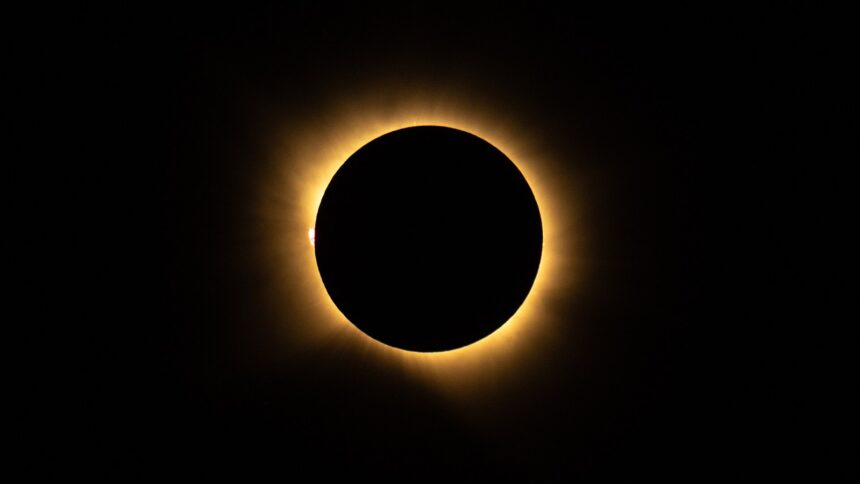
The path of totality crossed eastern Greenland, western Iceland and the Iberian Peninsula and ended over the Mediterranean Sea. Totality lasted longest, just under 2.5 minutes, off the west coast of Iceland. In Spain, which the Moon’s shadow reached shortly before sunset, it shrank to about a minute, the Associated Press reported.
“It’s simply impossible to imagine” (translated from Spanish)
Rosa Celiberti, a language teacher who watched the eclipse in Medinaceli
Spain: hundreds of viewing sites and heat
According to AP, about 350 official viewing sites were set up in the country’s sparsely populated interior, and Spain’s Interior Ministry deployed more than 33,500 law enforcement officers. Authorities expected at least half a million additional visitors, and hotels in A Coruña, Bilbao and Santiago de Compostela were fully booked. Temperatures at many viewing sites exceeded 35 °C, so people were urged to avoid areas at high risk of wildfires.
Iceland: clouds did not spoil the celebration
For Iceland, it was the first total eclipse since 1954, and in Reykjavík one was last seen in 1433. Despite clouds and rain, hundreds of people gathered at Hallgrímskirkja church and applauded both the darkness and the return of the light. The average price of a hotel room in the capital on the night of the eclipse exceeded $1,000. In Britain, the Moon covered more than 90% of the solar disc, something not seen there since 1999.
What’s next
As the European Space Agency notes, this is the first of three eclipses visible in Spain in 2026–2028. On August 2, 2027, there will be another total solar eclipse visible from Spain, North Africa and the Middle East, and on January 26, 2028, an annular eclipse will be visible over Spain and Portugal.