




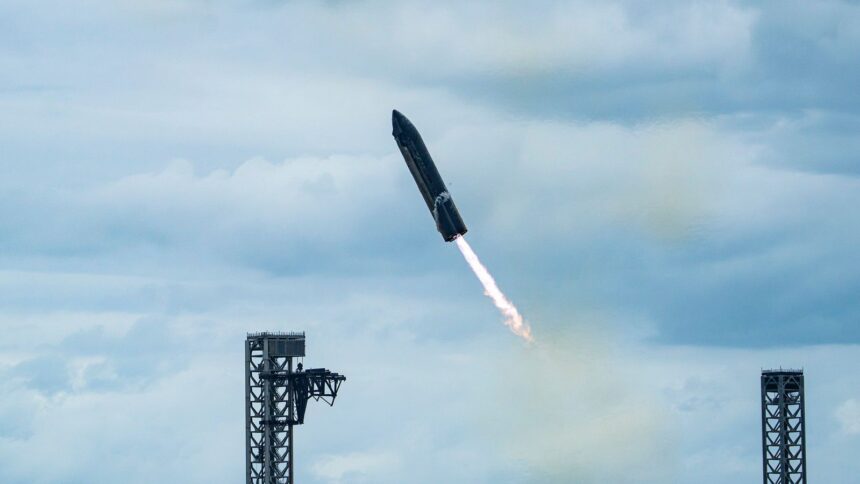
The fifteenth test flight lifted off on November 13 at 4:47 p.m. Texas time (00:47 on November 14 Kyiv time) from Pad 2 at Starbase. The next day, the ship returned to the same site: SpaceX described how, after a deorbit burn, Starship flew over the Gulf of Mexico, fired three Raptor engines to flip to a vertical position and slowly descended into the “arms” of the Mechazilla tower. It was the first catch of a Starship upper stage in the company’s history.
“Congratulations to the SpaceX team on another spectacular launch”
Jared Isaacman, NASA Administrator
How the flight went
According to the official mission description on the SpaceX website, the Super Heavy booster lifted off on 33 Raptor engines, after which the ship separated by “hot staging” and continued on its own six engines. Once in orbit, Starship deployed 26 third-generation Starlink satellites; SpaceX said it had established contact with all of them. The ship then spent more than 20 hours in space while the team monitored its systems, before performing a deorbit burn with a single engine.
- ship flight time: about 22.5 hours;
- number of orbits: 14 (according to Interesting Engineering and CBS);
- payload: 26 Starlink V3 satellites;
- height of the fully stacked rocket: 124 m (according to Universe Today).
What happened to the booster
Both stages were meant to be caught, but this did not happen. According to SpaceX, the booster relit 32 of its 33 engines for the boostback burn, but the burn ended early due to a low propellant mass signal; the cause is under investigation. The flight control system automatically called off the tower landing and diverted the booster out to sea. Super Heavy performed a landing burn over the Gulf, after which the flight termination system activated. Webcast host Jessie Anderson explained the decision by safety: “Safety is always our number one priority.”
Why it matters
SpaceX is building Starship as a fully reusable system, and returning the ship from orbit to the tower is a key step toward that. The company had previously caught boosters, but never the upper stage. Only on September 28, during the 14th flight, did Starship reach orbit for the first time; on that occasion the ship ended its mission with a splashdown in the Pacific Ocean. CBS notes that the ship still has to prove it can be quickly readied for another flight after reentry.
The US lunar program also depends on Starship: NASA has selected it as the lander for future Artemis missions. According to CBS, the agency expects a crewed Moon landing no earlier than 2028. Universe Today writes that next year NASA plans to test Starship and Blue Origin’s lander in low Earth orbit as part of the Artemis III mission.
What’s next
SpaceX has not yet announced a date for the 16th flight. According to specialist media, it could be the first Starship launch from Launch Complex 39A in Florida. Meanwhile, engineers are investigating the early shutdown of the booster’s engines, which prevented both stages from being caught on a single flight.