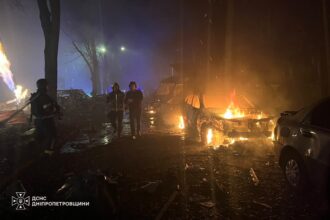




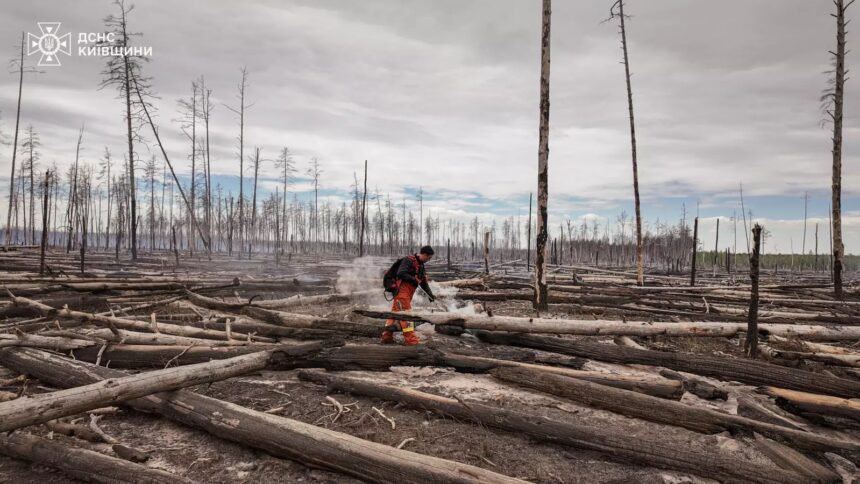
The fire has engulfed forests and dry vegetation on the territory of the Chornobyl Radiation and Ecological Biosphere Reserve. The State Emergency Service initially reported more than 1,000 hectares, and on May 8 more than 1,100. According to the reserve, one of the fires broke out after two Russian drones crashed inside the Exclusion Zone.
The situation is complicated by dry weather, strong winds and the danger of mines in some parts of the territory, which significantly limits the ability to carry out firefighting operations.
State Emergency Service of Ukraine
Wind spread the fire to new areas
On May 9, strong gusts of wind carried the fire from the Teremtsi to the Paryshiv nature conservation unit. Fires were also recorded in the Opachychi unit and the Korohod forestry. According to experts, the situation near the Prypiat River was the most difficult. In some areas, rescuers temporarily suspended work because of the threat posed by explosive objects.
According to Suspilne, 367 rescuers and 84 pieces of equipment were deployed to fight the fire. As of May 10, the State Emergency Service reported that 326 people were involved in the operation, including 211 of the service’s rescuers.
What about radiation
The State Agency for Exclusion Zone Management reported that the gamma radiation dose rate is within the long-term values for the area, at 0.19 to 0.35 μSv/h. State Emergency Service spokesperson Oleksandr Khorunzhyi dismissed rumours of a supposed “radioactive cloud” moving towards Kyiv.
The State Nuclear Regulatory Inspectorate specified that in air samples taken on May 8 at a distance of 30–150 metres from the fires, the concentration of caesium-137 reached 680 μBq/m³. This is above the control levels for the zone but well below the limit set by radiation safety standards, 0.8 Bq/m³. Modelling results show that permissible concentrations for the public are not expected to be exceeded outside the zone.
The regulator’s experts explained that during prolonged burning, combustion products rise into the upper layers of the atmosphere and can be carried over long distances, so a short-term increase in caesium-137 concentrations is possible where they settle. However, according to the regulator, the fires only redistribute radionuclides that are already present in the ecosystems and do not create additional risks that would require protective measures for the public.
Read also
What’s next
Rescuers are working with respiratory protection, focusing on containing the hotspots and creating firebreaks. The Interior Ministry urged people to rely only on official information about the radiation situation.