



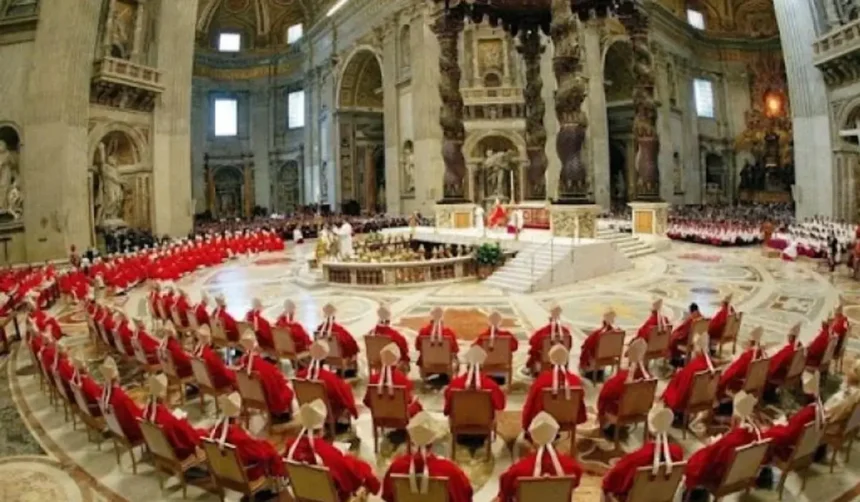
The passing of Pope Francis has saddened the entire Catholic world, but it has also raised a question: who will succeed him? The conclave will probably begin in early May, and for now the whole world is waiting.
DW has looked at the possible contenders to succeed the pope.
As before, there are no official lists of candidates: each cardinal writes a name on a ballot, and the favourite only emerges during the voting. And when the result is in, white smoke will rise over the Vatican.
The main contenders today are said to be three Italians who broadly continue Francis’s course.
Cardinal Pietro Parolin, 70, the Vatican’s Secretary of State, is regarded as an experienced diplomat with an impeccable reputation. He is distinguished by his restrained style, deep knowledge of international politics and the support of many European cardinals.
Pierbattista Pizzaballa, 60, the Latin Patriarch of Jerusalem, caught the world’s attention in October 2023 when he offered himself in exchange for hostages taken by Hamas. The gesture earned him respect even among people far removed from the Catholic Church.
Read also

Another strong candidate is the Archbishop of Bologna, Matteo Maria Zuppi, 69. He is known in Italy not only as a churchman but also as an active participant in public debate, able to speak about complex topics in simple language. Zuppi enjoys support among liberal-minded believers.
No Italian has been elected pope since 1978, but Italians still retain influence at the conclave. However, only 18 of the conclave’s participants are Italian, and representatives of 71 countries in total will take part in the vote.
A pope from the US is unlikely. Cardinal Raymond Leo Burke, one of Francis’s fiercest critics, is too conservative for most cardinals. In addition, since Donald Trump’s presidency, American candidates have carried less weight in the Vatican.
Attention is also focused on cardinals from other regions. Among them is 67-year-old Filipino Luis Antonio Tagle, a charismatic leader long seen as a “pope of the future”. Catholicism is growing in Asia, and a candidate from the Philippines could become a symbol of that trend.
There are other possible figures, such as 74-year-old Mexican Carlos Aguiar Retes. But his chances are slim because of the complicated relations between Mexico and the US.
The choice of a pontiff from Africa or Germany is less likely. Cardinal Robert Sarah of Guinea will soon reach the age of 80 — the limit for taking part in the election. The German Gerhard Ludwig Müller, known for his sharp statements, is unlikely to win enough support.
The election could also be affected by the sexual abuse scandal in the church. A wave of investigations and protests is increasing pressure on the cardinals, and some American groups have already announced plans to scrutinise the biographies of conclave participants in search of compromising material.
The election will last as long as it takes to reach agreement. The winner will be announced by white smoke over the Sistine Chapel. And, as the story of 2013 showed, when Jorge Mario Bergoglio unexpectedly became Pope Francis, the outcome may come as a complete surprise to the whole world.