




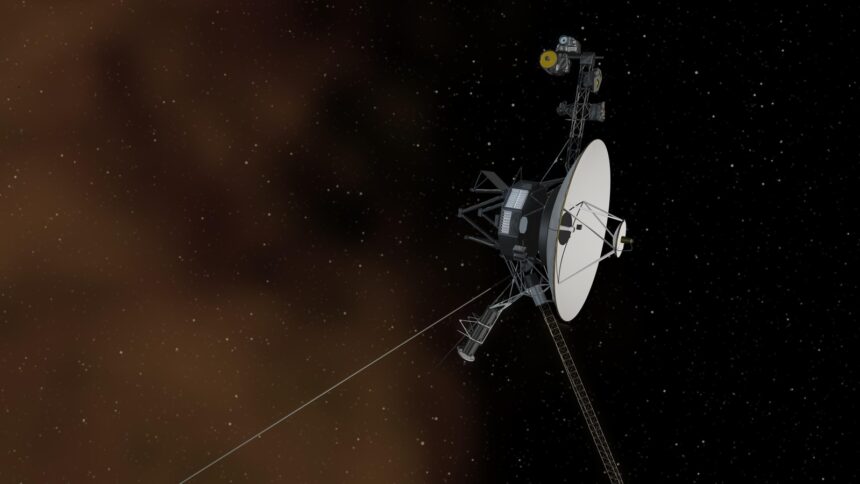
According to the agency’s calculations, Voyager 1 crossed this milestone on November 18, 2026, at 2:16 a.m. Pacific time (12:16 Kyiv time), after more than 49 years in flight. The probe was launched in 1977. It is now travelling at about 61,000 km/h, and in 2012 it became the first human-made spacecraft to enter interstellar space.
“Even at the speed of light, signals now take 24 hours to reach the spacecraft and another 24 hours to get back to us.”
Suzanne Dodd, Voyager project manager at NASA’s Jet Propulsion Laboratory
What is a light-day
A light-day is the distance light travels in a vacuum in 24 hours. For comparison, according to NASA, sunlight reaches the Moon in about 1.3 seconds, Neptune in about 4 hours, and Voyager 1 about 20 hours after that. Yet the probe is still very far from a light-year, which is 9.46 trillion km.
A record amid a glitch
The milestone coincided with a technical problem: since November 14, the team has received neither science nor engineering data from Voyager 1. The spacecraft is still sending a carrier signal, and it was this signal, together with trajectory calculations, that engineers used to confirm the achievement. The cause of the glitch is still being analysed.
“Passing one light-day is a unique feat for a spacecraft, but Voyager is much more than just a distant traveller,” said Joe Westlake, director of NASA’s Heliophysics Division.
What’s next
Both Voyagers lose about 4 watts of power every year. This year, engineers switched off three devices on them and replaced them with less power-hungry ones. NASA estimates this should keep the science instruments running at least until the 50th anniversary of both probes’ launch in summer 2027. Voyager 1 carries the Golden Record with sounds and images of Earth.