



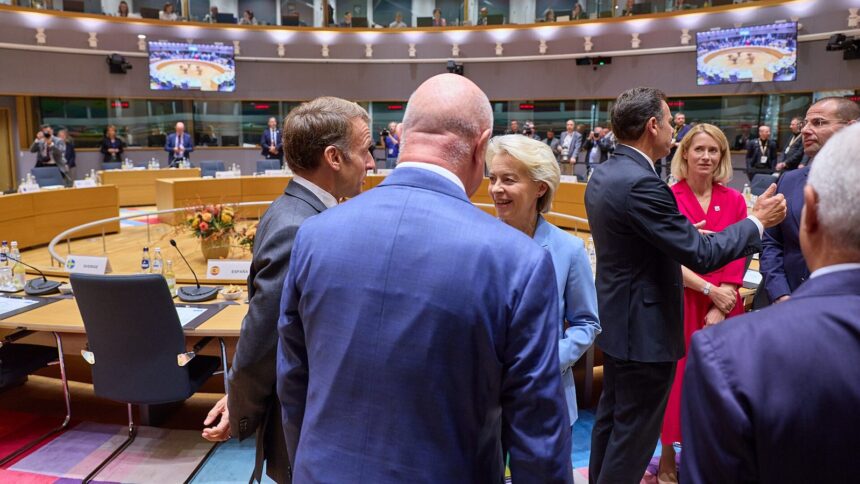
The European Council meeting took place on October 15–16, 2026. Ukrainian President Volodymyr Zelensky took part in an exchange of views with EU leaders and asked for at least €70 billion more for next year. According to him, as quoted by Al Jazeera, the war will cost Ukraine €155 billion in 2027. The summit took place against the backdrop of escalating tensions between Washington and Kyiv.
Now is not the time to scale back support for Ukraine. Now is the time to step up our support and step up our pressure.
António Costa, President of the European Council
What the EU decided on Ukraine
In the summit conclusions (document EUCO 14/26), EU leaders set out several specific decisions and positions:
- they welcomed the ongoing disbursements from the €90 billion support loan for Ukraine for 2026–2027 and noted that funding for Ukraine’s budgetary and defence needs for 2026 has been secured;
- they welcomed the agreement to release €6.6 billion from the European Peace Facility for military aid;
- they welcomed the creation of the Integrated Missile Defence Coalition and the extension of the mandate of the EU training mission EUMAM Ukraine;
- they called for urgently strengthening Ukraine’s air and missile defence and its energy system before winter;
- they welcomed the opening on October 13 of negotiating clusters 2 and 3 on Ukraine’s accession to the EU;
- they noted the extension of temporary protection for Ukrainians in the EU until March 2028.
On Kyiv’s additional financial needs, the leaders are awaiting an updated assessment from the European Commission and the IMF and promised to return to the issue “in due course.” Estonian Prime Minister Kristen Michal suggested that the EU will probably have to give Ukraine a new loan, while Austrian Chancellor Christian Stocker urged caution about large new commitments, Al Jazeera reports.
Sanctions and differences with the US
The leaders welcomed the adoption of the 21st sanctions package against Russia and called for new steps to cut its energy revenues and combat its shadow fleet, including through more vessel inspections. The conclusions state explicitly that the European Council “regrets” the US decision to temporarily lift sanctions on Russian diesel fuel. According to Euronews, Bulgaria’s prime minister spoke in favour of that deal, breaking from the common position.
The EU also condemned the so-called “elections” organised by Russia in the temporarily occupied territories of Ukraine and the attacks on civilian vessels in the Black Sea, including in the economic zones of Bulgaria and Romania. “Russia is trying to destroy energy and water infrastructure. But we stand by your side,” said European Commission President Ursula von der Leyen.
Europe’s defence
The leaders condemned Russia’s “increasingly reckless” behaviour, hybrid attacks and violations of EU countries’ airspace. They pledged to consider new restrictive measures and a review of visa policy towards Russian citizens, backed the Eastern Flank Watch project and called for the proposal on military mobility to be adopted by the end of the year. They separately stressed the need to integrate Ukraine’s defence industry into Europe’s.
Read also
No deal on the budget
No agreement was reached on the EU’s multiannual financial framework after 2027. According to Euronews, the negotiations will now be led by Costa himself, who is to present a compromise ahead of a special summit on November 26. The conclusions note that a deal is needed by the end of 2026 so that EU funding reaches recipients without interruption from January 2028.
What’s next
The European Council promised to return to the issue of Ukraine at its next meeting. The key question is how to cover Kyiv’s financing gap for 2027: the European Commission is to propose options. “Last winter was already hell, this one will be like hell again,” Estonian Prime Minister Michal warned.